When I See Him Again
A story about a story I never knew I was in

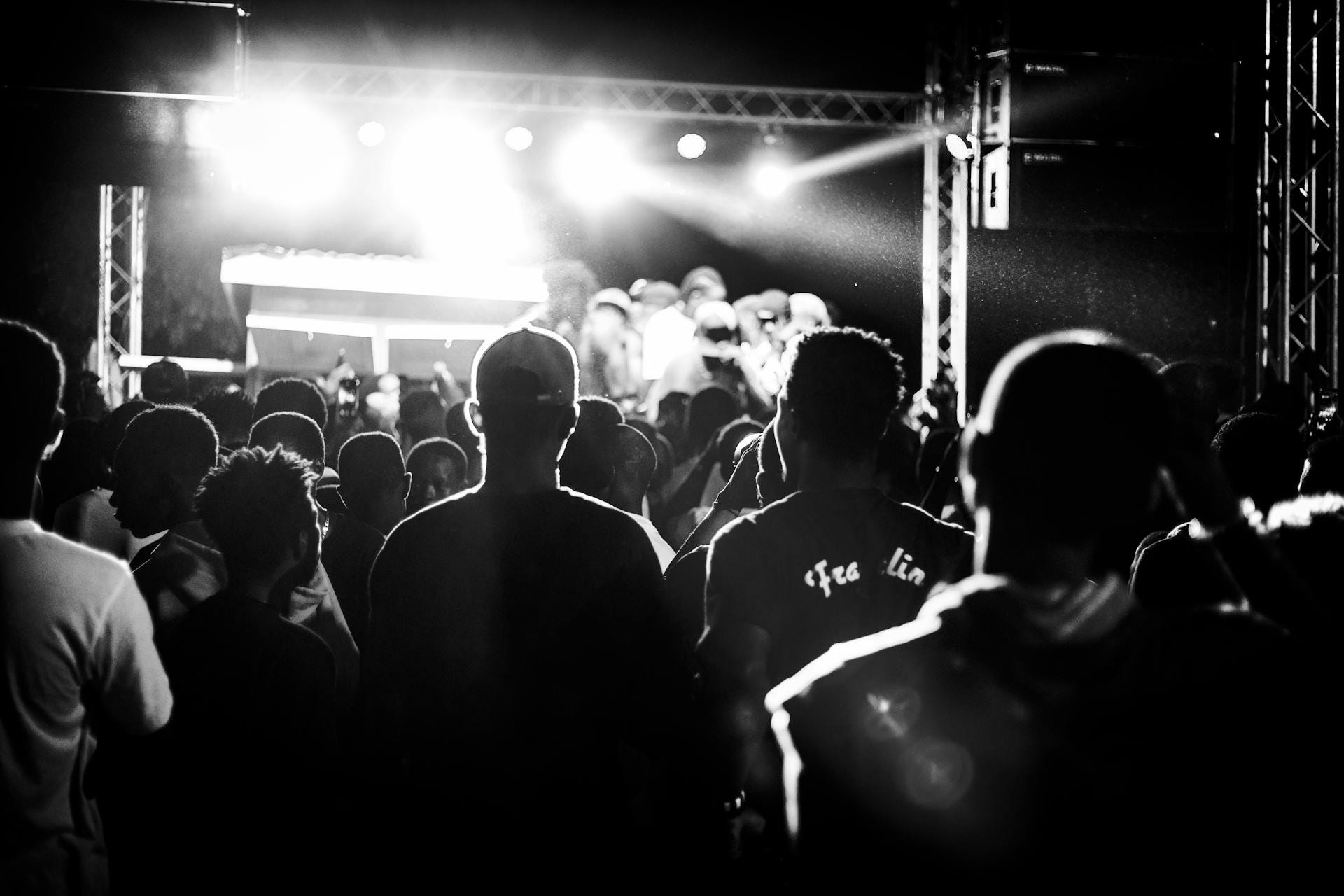
When I see him again, it’s by accident.
We’re halfway through the set, my sister is shouting something in my ear that I can’t hear, and my plastic cup is sweating in my hand. The band is chewing through a song everyone else seems to know the words to. The room smells like beer, detergent, and fifty borrowed nights out.
I’m scanning the crowd for the toilets when my eye catches on a profile I know.
It takes a second to place him. The hair is shorter, the shoulders slightly rounded, but the angle of his jaw is the same. It’s him. I haven’t thought of him in years.
I touch my sister’s arm — “Back in a sec” — and start to thread my way through the bodies, my drink held up high out of danger.
He turns as if he’s felt me coming.
For a heartbeat we just look at each other. I’m smiling but the smile I was expecting in return never arrives.
Something else crosses his face instead.
When I was seventeen, my weekends started under a sagging white canvas in a car park, selling clothes at a market stall.
We’d haul rails out of a van at some unkind hour, fingers numbed by metal in winter, sun already pricking the back of your neck by spring. The stall belonged to a woman who paid us in cash and folded loyalty into extra shifts. Most of the time she paired me with other girls my age. But sometimes, when she was short or knew it was going to be busy, she brought in a friend of hers to help her out.
He was twenty-one, at university and reading big books. Quoting Monty Python without having to think about it. He knew how to charm customers just enough to make them buy and leave smiling.
We slipped into a rhythm quickly. Long days will do that. We invented small rituals: the way we folded and stacked T-shirts, the lines from sketch shows we threw back and forth whenever it went quiet. He listened when I talked, remembered details about school and friends, didn’t treat me like a child even though I was.
He also liked to needle me, the way boys do when they’ve learned that irritation is safer than sincerity. One afternoon, after he’d pushed one joke too far, I snapped, “God, you’re so frustrating I could jump on you right now.”
Because where I came from, raised by a single father on WWE and sisterly play fights, jump on you meant a full body tackle to the floor, pinning someone until they surrendered. I meant it scrappy, half a threat and half a dare.
He froze. Went very still and very careful. Then I froze as I realised there was a maybe living under my words.
I had no real experience, no stable list of signs to tick off. I only knew that sometimes his gaze stayed on my face a fraction longer than it needed to, or that his shoulder brushed mine when there was plenty of space. It could have been nothing. It could have been everything. At seventeen, those feel like the same thing.
One afternoon, at packing-up time, he offered me a ride home.
It was practical. I lived vaguely in his direction, the buses were slow… but in my head this was where the story might finally do something. The first time it would be just the two of us, in a car, no customers, no boss in the background.
We drove mostly in silence, some local radio station filling the gaps. I watched the familiar streets slide by, waiting for the air to thicken into something else. A question about boyfriends. A comment about us. Anything.
At my front gate he pulled up, cut the engine and turned to me.
“Have you got any money for fuel?” he said.
I blinked at him. Then at the dashboard. Then at my own hands, already rummaging in my bag before I’d quite found the feeling that went with it.
Of course I had money. That was why I was there every weekend. I fished out a few notes and handed them over. He took them with a quick “Cheers,” smiled the general purpose smile he used on strangers, and said, “See you next week.”
On the walk down the driveway, I rewrote the story I’d been telling myself. If he’d been interested, he would have waved it off, made a joke of it. He would have dragged out the moment at the gate instead of squaring the ledger and driving away.
After that, I tried to stop reading meaning into every small thing. He was older, clever, kind. I let myself enjoy that.
But it didn’t stay put.
In the weeks before New Year’s we did the usual vague talk about plans. I said I wasn’t sure yet. He made a noncommittal noise. On the night itself, between me and my sisters the house already full of the getting ready mess of hair spray and borrowed clothes, the phone rang. It was him.
“What are you doing?” he asked.
I told him over the noise, about the party I was going to. He said he was heading out with some of his friends, that I should come. His voice sounded different over the phone, closer.
“I can’t,” I said, apologetic. “Maybe another time?”
“Sure,” he said slightly disappointed.
I put the receiver down and stood looking at it for a moment. Then I finished my eyeliner and went where I was already expected.
At the stall, a little while later, I told him about some boy my own age who’d gone suddenly cold. He listened, stacking folded tops with more force than they required.
“I can beat him up for you,” he said, light on the surface but with just enough weight under it.
He held my eye for a second too long after he said it.
I laughed, cheeks hot, and changed the subject.
There were no more comments like that, nothing you could pin to the wall, until several weekends later. The afternoon had thinned out; the market was in that lull between busy and done, and there was nothing to do but fill the empty time with chatter.
We were talking about everything and nothing when he told me about a girl who liked him. Someone at uni. He said it casually, but he watched me from the corner of his eye.
“She’s interested,” he said, fiddling with a stack of tags. “But I’m not ready.”
“Why not?”
He went quiet in the particular way that makes everything around you feel suddenly too loud. His shoulders folded inwards, like he was protecting something from my question. He stared past the hanging rail, refusing to meet my eye.
“Because I’m still in love with someone else,” he said, barely above a whisper.
I knew, in that instant, who he meant. Or thought I did.
“Who?” I asked.
He didn’t answer. His gaze slid away towards the row of blouses. His mouth opened and closed on nothing.
Before either of us could decide what to do next, a customer ducked under the canvas and asked for another size. We moved apart automatically, back into the roles we knew: smile, fetch, fold, take money. By the time she’d gone, the moment had retreated to somewhere it would be heavier to touch than to leave it alone.
We both let it stay there.
Then school ended. University brochures, big open questions about the rest of our lives. I decided to leave, to go and work as an au pair in America for a year.
At the stall I told him, the way I told everyone, that I was going abroad.
“Wow,” he said. “That’s… big.” A couple more questions. Where. When. Did I know anyone there?
He did not say don’t go.
If there was a last day, I don’t remember it clearly. I remember packing rails into the van, canvas coming down, my boss counting the float. I remember him saying, “Let me know how it goes,” and me saying, “I will,” in the automatic way you say it to people you like and might never see again. We probably awkwardly hugged.
And then I went.
I stand frozen as his shoulders tighten. His gaze is still cold and his face unsmiling. Then his hand shoots sideways, finds the woman next to him and yanks her a step forward so she’s standing directly between us.
“I’d like you to meet my wife,” he says.
His voice is steady enough but his knuckles are white around her fingers, his eyes unflinching, and he has yet to smile at me.
She blinks, smiles at me, and offers her name. I offer mine. The band hits the chorus of something loud and for a moment our mouths are moving and nobody can hear anyone. We all laugh too hard in that way that belongs more to the noise than to the joke.
When the volume dips, we fall into the only script available: what are you doing now, where are you living, how long have you been together. His wife fills in soft details about their flat, their routines. Every now and then she glances from his face to mine, as if trying to place me.
He watches me while she speaks, like he’s waiting to see something register.
“Are you here just for the weekend?” he asks.
“Yeah. Seeing family.”
He nods. He doesn’t ask anything that would produce a future. No we should catch up, no you should see so-and-so again. He keeps us pinned in this tiny, overlit scene.
Someone at my back jostles my arm; beer slops up the side of the cup and onto my fingers. I wipe them against my jeans.
Eventually, the conversation runs out of surface.
“Well,” I say, because there’s nothing else, “it was really good to see you.”
“Yeah. You too.”
I step backwards first, then turn and let the crowd fold between us. My sister leans in: “Who was that guy?” I say, “Just someone I used to work with,” and hear how thin it sounds even as it leaves my mouth.
We stay for a couple more songs. I stare into my drink looking to name how I feel but nothing comes. I tell my sister I’d like to leave. On the way home she says, “He was weird,” and I shrug.
Later, in bed, the scene replays itself with the volume turned down. The market stall. The car. The fuel money. I can beat him up for you. I’m still in love with someone else. The way I said who? and enjoyed, for a second, the idea that he meant me.
The way he looked at me over a rail of blouses; the way he looked at me over his wife’s shoulder. The white knuckles. The wife who kept glancing at my face…
It all feels, unreasonably and completely, like being punished for a test that I was never told I was taking.
This is quietly devastating.
You captured so well the cruelty of ambiguous tenderness; those half-signals that ask someone to understand, but never give them enough honesty to stand on.
“It felt like being punished for a test I was never told I was taking” is such a sharp ending. There’s much ache here.
Your writing is like when a star jasmine blooms... indescribably beautiful and nuanced. The world smiles at seeing your words wake us up once again 🙏🌿